

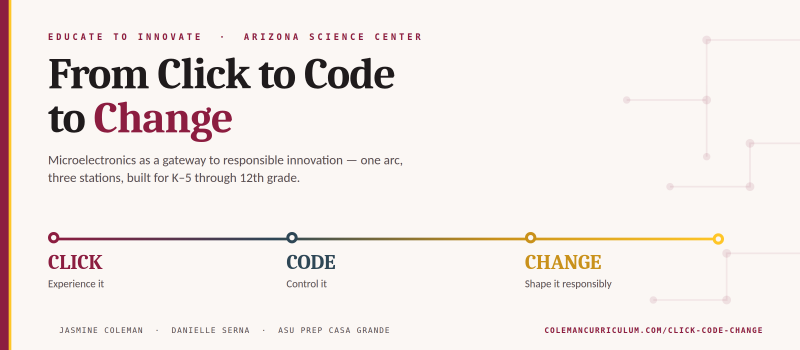
Experience it. Control it. Shape it responsibly.
CLICK — minutes 0–10
How does electricity make something happen?
A complete path makes something happen: input, path, output. Teachers finish a circuit that is
missing exactly one wire — then pull it back out.
CODE — minutes 10–25
What changes when I can program the response?
The music chip plays what its designer decided. The micro:bit guitar plays what you decide.
Hard stop at minute 25, even mid-debug.
CHANGE — minutes 25–53
What responsible future is possible?
Question, trace, imagine, act. The chip you held in minute two becomes a supply chain, a set of
trade-offs, and a career pathway that starts in Arizona.
The arc stays the same. Three dials move.
| Band | Click — experience it | Code — control it | Change — shape it |
| K–5 | Paper circuits. Copper tape, an LED sticker and a coin cell. Close the loop, then break it. | Unplugged. Arrow cards a partner follows exactly, on a 6×6 plate. Debug the one wrong card. | Brick Circuits. Stamp two pattern layers on the wafer sheet. Chips are made in layers, by people. |
| 6–8 | Snap Circuits. Find the gap in the path, snap in the missing wire, name input, path and output. | micro:bit blocks. On button A pressed, show an icon. Change one thing, download again. | Supply chain trace. Materials, places, people, disposal — laid out in a line on sticky notes. |
| 9–12 | Snap Circuits + the IC. Voltage, current, resistance — and a chip whose behavior someone chose. | micro:bit guitar. Foil pads on pins 1, 2 and GND. Your body completes the circuit. | Principled Innovation. Can we? Should we? Who benefits? What future? Then one real action. |
| Band | Click — experience it | Code — control it | Change — shape it |
One safety note for K–5. Coin cell batteries cause serious internal injury if swallowed. An adult hands them out and collects them, and they stay bagged until the moment of use. Never leave loose cells on an elementary table.
Kits, code and Arizona pathways
| Link text | URL | One-line description |
| micro:bit guitar — touch tunes | https://microbit.org/projects/make-it-code-it/guitar-1-touch-tunes/ | The build we ran, with starter code. Pins 1, 2 and GND; a V2 has the speaker built in. |
| Microsoft MakeCode for micro:bit | https://makecode.microbit.org/ | Block editor, browser-based, free. Open it before a lesson, not during one. |
| Brick Circuits — lithography with LEGO | https://linktr.ee/brickeducationkits | The stamping kit from the CHANGE station, plus the intro video. Each box supports four students. |
| Chibitronics paper circuits | https://chibitronics.com/ | LED stickers, copper tape and card templates. The cheapest way to put a circuit in 30 hands. |
| Semiconductor Technician Quick Start | https://info.maricopacorporate.com/semiconductor | Ten days, free to Arizona residents, at Maricopa community colleges. There's a version for teachers and counselors. |
| Principled Innovation | https://pi.asu.edu/practice/the-fundamentals-of-pi | The framework behind the CHANGE questions, from ASU's Mary Lou Fulton College. |
Who ran this session
Jasmine Coleman — STEM Transformational Teacher Lead, chemistry and physics, ASU Preparatory Academy – Casa Grande.
Danielle Serna — Humanities Transformational Teacher Lead, same campus.
Want this session, or a version of it, for your school or district? Get in touch.